Here is another little video about the English Foundation Program at the University of British Columbia's Okanagan campus:
Wednesday, November 20, 2013

Saturday, November 09, 2013
I have a new article in the Canadian Journal of Applied Linguistics
I just has a peek at the Canadian Journal of Applied Linguistics, and my latest article has been published! The web address for this journal is: http://journals.hil.unb.ca/index.php/CJAL.
Here is the abstract for my article:
You can go directly to the article here:
http://journals.hil.unb.ca/index.php/CJAL/article/view/21176
Here is the abstract for my article:
The Lexical Breadth of Undergraduate Novice Level Writing Competency
Abstract
This study builds on previous work exploring reading and listening lexical thresholds (Nation, 2006; Laufer & Ravenhorst-Kalovski, 2010; Schmitt, Jiang, & Grabe, 2011) in order to investigate productive vocabulary targets that mark successful entry-level undergraduate writing. Papers that passed the Effective Writing Test (EWT) were chosen to create a corpus of novice university level writing (N = 120). Vocabulary profiles were generated, with results indicating the General Service List (GSL) and the Academic Word List (AWL) cover an average of 94% of a typical paper. Further analysis pointed to 3,000 word families and 5,000 word families covering 95% and 98% respectively of each paper. Low frequency lexical choices from beyond the 8,000 word family boundary accounted for only 0.6% coverage. These results support the frequency principle of vocabulary learning (Coxhead, 2006), and provide lexical targets for English for Academic Purposes (EAP) curriculum development and materials design.
Résumé
Cette étude s'appuie sur des travaux antérieurs qui explorent les niveaux lexicaux pour la lecture et l’écoute (Laufer et Ravenhorst-Kalovski, 2010; Nation, 2006; Schmitt, Jiang et Grabe, 2011). Elle a pour but d'étudier les niveaux de production lexicale qui marquent l'écriture à l'entrée à l'université anglophone. Pour créer un corpus d'écriture de niveau universitaire novice, 120 articles qui ont passé le Effective Writing Test (EWT) ont été choisis. Des profils de vocabulaire ont été générés et les résultats signalent que la General Service List (GSL) et la Academic Word List (AWL) couvrent une moyenne de 94% d'un document typique. En plus, 3 000 familles de mots et 5 000 familles de mots couvrent 95% et 98% respectivement de chaque article. Les choix de basses fréquences lexicales au-delà de la limite de 8 000 mots ne représentaient que 0,6% de la couverture. Ces résultats appuient le principe fréquence de l'apprentissage du vocabulaire (Coxhead, 2006) et fournissent des niveaux lexicaux pour les programmes d’anglais à des fins académiques.
Keywords
Vocabulary; Composition; Undergraduate Studies; English for Academic Purposes; English (Second Language)
http://journals.hil.unb.ca/index.php/CJAL/article/view/21176
Monday, October 28, 2013
TESL Ontario Plenary Speaker
I've just come back from the TESL Ontario conference, and my head is swimming with new and exciting ideas. Here is one that I introduced at the conference:


I'm working on a paper right now to explain this additional language acquisition formula, but I wanted to put it on my blog to peak people's curiosity. This formula is tweaked for vocabulary acquisition, but it is the same as my one for additional language acquisition. Here is the breakdown:
f = focus on form
s = strategies
i+1 = comprehensible input
2 = interaction
m = motivation
i = identity
t = teacher effects
VA = vocabulary acquisition
If you would like to cite this for a paper, please use:
Douglas, S. (October 2013). Pathways to Production: Exploring Lexical Thresholds in Speaking and
Writing. Teachers of English as a Second Language Association of Ontario
Annual Conference, Toronto, Ontario. Keynote
Address.
Academic Inquiry: Writing for Post-secondary Success
I'm happy to say that my new book has just been published by Oxford University Press Canada:
http://www.oupcanada.com/catalog/9780199004553.html
Thanks to all of the hard working folks at OUP Canada who made this happen!
http://www.oupcanada.com/catalog/9780199004553.html
Thanks to all of the hard working folks at OUP Canada who made this happen!
Friday, February 15, 2013
The English Foundation Program at UBC's Okanagan Campus
Here is a new video about the English Foundation Program at UBC's Okanagan campus. I've very proud of how well the students have been doing in the first year of this program. They are a real credit to the university!
Thursday, July 05, 2012
Thoughts on Thematic teaching in English for Academic Purposes
Language Through Content
At a macro-design level, one way to organize an English for Academic Purposes (EAP) curriculum is through thematic language through content organization. In this curriculum design structure, the conditions for language acquisition are created in the context of complex meaningful content from various disciplines across the undergraduate curriculum. This promotes the teaching of language and content together to provide a framework for language, concepts, and learning strategies. Thus, an EAP course can use the content of the various disciplines at a research intensive university to improve students’ general knowledge while at the same time fostering an increase in English language proficiency. This approach makes content a vehicle for reading, writing, listening and speaking skills while at the same time integrating grammar and vocabulary development. From this, a powerful framework for learning is created to contextualize the academic objectives of the EAP courses.
The Spiked English Language Proficiency Model
As students work through a thematic unit of inquiry, their English language proficiency in relation to the content studied spikes so that they become competent users of English within the thematic area under study. While a student’s general English language proficiency might be that of a high intermediate student, within a completed thematic unit of inquiry, the same student may function as an advanced user of English. As students work through the various thematic units of inquiry, spiked thematic proficiency multiples through a variety of academic disciplines creating an ever expanding linguistic framework upon which to map new knowledge and language (see Figure 1).
Figure 1
The Spiked English Language Proficiency Model

At a macro-design level, one way to organize an English for Academic Purposes (EAP) curriculum is through thematic language through content organization. In this curriculum design structure, the conditions for language acquisition are created in the context of complex meaningful content from various disciplines across the undergraduate curriculum. This promotes the teaching of language and content together to provide a framework for language, concepts, and learning strategies. Thus, an EAP course can use the content of the various disciplines at a research intensive university to improve students’ general knowledge while at the same time fostering an increase in English language proficiency. This approach makes content a vehicle for reading, writing, listening and speaking skills while at the same time integrating grammar and vocabulary development. From this, a powerful framework for learning is created to contextualize the academic objectives of the EAP courses.
The Spiked English Language Proficiency Model
As students work through a thematic unit of inquiry, their English language proficiency in relation to the content studied spikes so that they become competent users of English within the thematic area under study. While a student’s general English language proficiency might be that of a high intermediate student, within a completed thematic unit of inquiry, the same student may function as an advanced user of English. As students work through the various thematic units of inquiry, spiked thematic proficiency multiples through a variety of academic disciplines creating an ever expanding linguistic framework upon which to map new knowledge and language (see Figure 1).
Figure 1
The Spiked English Language Proficiency Model

Thursday, June 28, 2012
New BC TEAL News Article: A Short Rational for Credit Bearing English for Academic Purposes (EAP) Courses
I've just had an article published in BC TEAL News: https://www.bcteal.org/wp-content/uploads/2012/06/BCTealSpring2012draft9-copy.pdf.
In the article, I'm basically looking at some of the reasons why English for Academic Purposes courses should bear credit that counts towards a degree. Have a read of the article and let me know what you think . . .
In the article, I'm basically looking at some of the reasons why English for Academic Purposes courses should bear credit that counts towards a degree. Have a read of the article and let me know what you think . . .
Monday, June 18, 2012
EAP Instructor Position at UBC's Okanagan Campus
It has just become official. The University of British Columbia's Okanagan campus is hiring a new instructor for the new English Foundation Program.
You can learn all about the English Foundation Program here:
http://www.ubc.ca/okanagan/students/efp/welcome.html
You can learn all about the new position here:
http://www.ubc.ca/okanagan/hr/careers/faculty/instructors/education.html
I'm posting a copy of the position just below. If you have any questions, please inquire at the email in the advertisement. Please don't contact me. I'm just passing along the information.
The deadline to apply is July 13, 2012.
Term Certain Instructor Position, English Foundation Program
The English Foundation Program (EFP) is new program that will enable domestic and international students to gain the English language proficiency skills required to be accepted into a degree program at UBC’s Okanagan campus. This innovative, accredited program combines intensive English language training and credit courses while engaging students in campus life.
We invite applications from qualified individuals for a full time, term certain instructor position commencing August 15, 2012.
The position involves daily lesson planning and course delivery in accordance with the English Foundation Program’s curriculum, diagnostic evaluation and testing, ongoing formative and summative assessment, and collaboration on curriculum design and program development.
The successful candidate will demonstrate expertise in teaching English for Academic Purposes (EAP) at the post-secondary level. This expertise includes innovative learner-centered approaches. Inquiry forms the centre of the ideal candidate’s teaching.
Preference will be given to applicants who hold a master’s degree in a relevant area, including formal coursework in teaching English as an Additional Language (EAL), and are committed to working collaboratively in an interdisciplinary environment. This includes demonstrated experience in working cooperatively with diverse groups in a multicultural and multilingual environment. Intercultural competence is essential. Proficient written and verbal communication skills are also a requirement for the position.
The successful candidate will further demonstrate a commitment to the integration of new technologies into his or her teaching. Additional experience in EAL teacher education and familiarity with the K-16 spectrum of EAL teaching is preferred. Membership in a related professional association (e.g. BC TEAL, ACLA/CAAL, TESOL) is desirable.
Applicants should forward a cover letter, curriculum vitae, statement of teaching philosophy, evidence of teaching ability (e.g. course evaluations) and the names, including contact information, of three referees to:
Dr. Lynn Bosetti, Dean of Education
UBC, Okanagan Campus
Faculty of Education
EME 3141, 3333 University Way
Kelowna, BC, V1V 1V7
www.ubc.ca/okanagan/education
Electronic applications are welcomed. Electronic applications must be submitted as e-mail attachments and sent to: Lesley Frost at lesley.frost@ubc.ca
Application Deadline: July 13, 2012
UBC hires on the basis of merit and is committed to employment equity. All qualified persons are encouraged to apply. We especially welcome applications from members of visible minority groups, women, Aboriginal persons, persons with disabilities, persons of minority sexual orientations or gender identities, and others with the skills and knowledge to engage productively with diverse communities. Government regulations require that Canadians and permanent residents of Canada will be given priority.
Only short-listed candidates will be contacted.
You can learn all about the English Foundation Program here:
http://www.ubc.ca/okanagan/students/efp/welcome.html
You can learn all about the new position here:
http://www.ubc.ca/okanagan/hr/careers/faculty/instructors/education.html
I'm posting a copy of the position just below. If you have any questions, please inquire at the email in the advertisement. Please don't contact me. I'm just passing along the information.
The deadline to apply is July 13, 2012.
Term Certain Instructor Position, English Foundation Program
The English Foundation Program (EFP) is new program that will enable domestic and international students to gain the English language proficiency skills required to be accepted into a degree program at UBC’s Okanagan campus. This innovative, accredited program combines intensive English language training and credit courses while engaging students in campus life.
We invite applications from qualified individuals for a full time, term certain instructor position commencing August 15, 2012.
The position involves daily lesson planning and course delivery in accordance with the English Foundation Program’s curriculum, diagnostic evaluation and testing, ongoing formative and summative assessment, and collaboration on curriculum design and program development.
The successful candidate will demonstrate expertise in teaching English for Academic Purposes (EAP) at the post-secondary level. This expertise includes innovative learner-centered approaches. Inquiry forms the centre of the ideal candidate’s teaching.
Preference will be given to applicants who hold a master’s degree in a relevant area, including formal coursework in teaching English as an Additional Language (EAL), and are committed to working collaboratively in an interdisciplinary environment. This includes demonstrated experience in working cooperatively with diverse groups in a multicultural and multilingual environment. Intercultural competence is essential. Proficient written and verbal communication skills are also a requirement for the position.
The successful candidate will further demonstrate a commitment to the integration of new technologies into his or her teaching. Additional experience in EAL teacher education and familiarity with the K-16 spectrum of EAL teaching is preferred. Membership in a related professional association (e.g. BC TEAL, ACLA/CAAL, TESOL) is desirable.
Applicants should forward a cover letter, curriculum vitae, statement of teaching philosophy, evidence of teaching ability (e.g. course evaluations) and the names, including contact information, of three referees to:
Dr. Lynn Bosetti, Dean of Education
UBC, Okanagan Campus
Faculty of Education
EME 3141, 3333 University Way
Kelowna, BC, V1V 1V7
www.ubc.ca/okanagan/education
Electronic applications are welcomed. Electronic applications must be submitted as e-mail attachments and sent to: Lesley Frost at lesley.frost@ubc.ca
Application Deadline: July 13, 2012
UBC hires on the basis of merit and is committed to employment equity. All qualified persons are encouraged to apply. We especially welcome applications from members of visible minority groups, women, Aboriginal persons, persons with disabilities, persons of minority sexual orientations or gender identities, and others with the skills and knowledge to engage productively with diverse communities. Government regulations require that Canadians and permanent residents of Canada will be given priority.
Only short-listed candidates will be contacted.
Tuesday, April 17, 2012
Visiting Taiwan
It's official. I'm travelling to Taiwan at the beginning of May to take part in Oxford Day. My talk is going to be on critical thinking and vocabulary and how the two are intertwined. In addition to Oxford Day in Taipei and Taichung, I'll also be making presentations at National Cheng Kung University (http://www.ncku.edu.tw/) and National Kaohsiung First University of Science & Technology (http://www.nkfust.edu.tw/). Here is some more information about my talk along with the poster:
Unlocking the Potential: Creative Thinking Skills and Lexical Proficiency
As English Language Learners ready themselves for participation in the globalized world of the 21st Century, a focus on inquiry, creative thinking, and problem solving is fast coming to the forefront of English language teaching. In order to employ critical thinking skills such as these, students require increasingly sophisticated levels of lexical proficiency. Exploration of the lexical demands of novice academic writing at the post-secondary level reveals vocabulary benchmarks and directions for language instruction that foster critical thinking skills and successful writing. In examining these aspects of vocabulary teaching and learning, seminar participants are encouraged to reflect critically on the presented ideas and plan strategies for unlocking the cognitive and academic English language potential of their students.
http://www.oup.com.tw/pics/2012OxfordDay/main.html
http://www.oup.com.tw/pics/2012NKFUT/main.html

Unlocking the Potential: Creative Thinking Skills and Lexical Proficiency
As English Language Learners ready themselves for participation in the globalized world of the 21st Century, a focus on inquiry, creative thinking, and problem solving is fast coming to the forefront of English language teaching. In order to employ critical thinking skills such as these, students require increasingly sophisticated levels of lexical proficiency. Exploration of the lexical demands of novice academic writing at the post-secondary level reveals vocabulary benchmarks and directions for language instruction that foster critical thinking skills and successful writing. In examining these aspects of vocabulary teaching and learning, seminar participants are encouraged to reflect critically on the presented ideas and plan strategies for unlocking the cognitive and academic English language potential of their students.
http://www.oup.com.tw/pics/2012OxfordDay/main.html
http://www.oup.com.tw/pics/2012NKFUT/main.html

Friday, November 11, 2011
Learning by Design: An Online Tool for EAL Curriculum Development
Here is the latest issue of the BC TEAL News.
https://www.bcteal.org/wp-content/uploads/2011/10/BCTealFall2011.draft_.11.1.pdf.
My article is on page 23. It's a review of Dr. Hetty Roessingh's online EAL curriculum development framework, Learning by Design.
https://www.bcteal.org/wp-content/uploads/2011/10/BCTealFall2011.draft_.11.1.pdf.
My article is on page 23. It's a review of Dr. Hetty Roessingh's online EAL curriculum development framework, Learning by Design.
Wednesday, October 12, 2011
Something I said in class the other day . . .
I was explaining the BICS-CALP framework (Cummins, 1981; Roessingh, 2006) to my students in the Elementary Teacher Education Program (ETEP) at UBC's Okanagan campus the other day, and here is something I came up with in class:
Part of our job as teachers is fostering the education of our learners' imaginations so that they can precisely articulate themselves in increasingly decontextualized and cognitively challenging academic endeavour. That precise articulation is unleashed with the ability to deploy an apt and varied vocabulary.
Part of our job as teachers is fostering the education of our learners' imaginations so that they can precisely articulate themselves in increasingly decontextualized and cognitively challenging academic endeavour. That precise articulation is unleashed with the ability to deploy an apt and varied vocabulary.
Sunday, September 11, 2011
An English as an Additional Language Philosophy of Principled Eclecticism
A teacher who does not take pedagogy seriously, who does not study, who teaches badly what she/he does not know well, who does not struggle to obtain the material conditions indispensable to education, that teacher is actively inhibiting conditions indispensable to education, that teacher is actively inhibiting the formation of intellectual discipline so essential to students. That teacher is also destroying herself/himself as a teacher.
Paulo Freire (1987), Letter to North American Teachers
Articulating a personal philosophy of education is not an easy task to undertake. Men and women have been grappling with the question of how to educate themselves and their children for thousands of years. It is the drive to fulfill human potential that pushes me to seek the best possible practice for my classroom. As such, I am not unwilling to look into all of the different traditions and pedagogies that have been espoused over the years to create my personal teaching philosophy. Furthermore, I strive to carry out a reflective teaching practice in which I constantly re-evaluate my teaching and work toward constantly better practice. Therefore, I ascribe to an eclectic approach which searches out methodologies appropriate for the context in which educators find themselves. Above all, this approach does not bury itself away in the pedagogy of the moment to the detriment of past successful practice and future innovation. It can be termed as a teaching philosophy of principled eclecticism, which has been described as a coherent and pluralistic approach to language teaching (Mellow, 2002; Larsen-Freeman, 2000). Within principled eclecticism, informed educators approach the task of developing a personal philosophy of education with a critical eye on the past and an inquiring eye to the future. This means looking to gather around the best tools to serve learners in their situated context in order to help them reach their fullest potential as human beings.
As a starting point, a traditional approach to education grounded in behaviourism and classical humanism can reveal a number of ideas which have value to the principled eclectic (see Bloom, 1956; Skinner, 1968). Examples of traditional approaches endure in the Canadian educational system. Especially at the tertiary level, there are times when a teacher fronted lecture can fulfill a valuable role in the transmission of knowledge and be part of a student centred teaching philosophy. While rejecting the elitist notions of classical humanism, I am attracted to the idea of transmitting cultural heritage from one generation to another. We do not live in a cultural vacuum, and an understanding of what our culture has created in the past can have a profound effect on where our culture will be going in the future. Neither a person nor the language they speak is ahistorical. Many of the core concepts upon which Canadian society is based come from the cultural outpourings of the past from as far back as the ancient Greeks and Hebrews. Cultural outpourings from the past that were valued in former ages do have a place in modern education. To be a participatory member of a modern democratic society, it is important to be both culturally and linguistically articulate. However, this should be done with a critical eye that weighs the values that are inherent in our cultural heritage and understands the roles that this heritage can assign to the various members of our society. The power of reason so valued by the classical humanists is not to be cast aside either. An educational system that produces students who are able to reason produces students who will be able to consider the world with a critical eye that can question the world rather than accept the status quo. Through this process of questioning our students can come to a greater awareness of the reality that surrounds them. The teaching situation will call for the teaching approach, and the teacher, as an informed practitioner, will match the pedagogical approach with the situation, looking at times to behaviourism and classical humanism to guide teaching practice.
However, this is not the only way to teach for a principled eclectic. Taking a more constructivist approach to education can also be incorporated into a teaching philosophy of principled eclecticism (see Dewey, 1944; Piaget, 1952; Vygotsky, 1978). The idea that education can be an instrument of social change is laudable. Tied to this idea is the assumption that schooling affects the level of economic growth and progress in a society. A second assumption is that education is capable of redressing social inequalities through the equalization of educational opportunity (Apple 1979). Thus, the acquisition of knowledge can be seen as an active social process in which the teacher plays the role of a facilitator or guide. In his or her role of facilitator, a teacher can use authentic materials in a classroom where the students are actively engaged in the process of learning and are provided with the intentional teaching and support needed to become productive and contributing members of the class. Here, the functional notational approach to language teaching is chosen over the grammar translation method. While at times the classical didactic teaching of a grammar rule can play a valuable role in the education of the student, other times it is important to highlight the pragmatic functions that the forms of a language can play. Because of the various salient aspects of constructivist methodologies, the informed educator will not ignore this approach when making decisions about his or her practice. In order to ensure active learning, this entails adding a layer to my teaching philosophy that embraces an inquiry based approach that fosters the research skills and initiative students need to reach their educational goals.
A further vital part of my principled eclecticism is the idea that education is an emancipatory, empowering, enabling, and democratizing endeavour (see Friere, 1970; Krashen, 1987; Giroux, 2006). Education is about the growth and self-realization of the individual. The teacher should aim to be a transformative intellectual who is a partner in learning. In the words of Freire “the teacher is no longer the-one-who-teaches, but one who is himself taught in dialogue with the students, who in turn while being taught also teach” (Freire, 1970, p. 67). At times, this too can be a valuable role for the teacher. The teacher can learn from the students, just as the students can learn from the teacher. Using this philosophy, the classroom becomes a community of learners that includes the teacher. The students are full partners in their learning, and the curricular goals are co-created and shared. Housed in this philosophical approach are the whole language and language experience methods which are important tools in the methodological bag of any teacher. Once again, the method matches the situation, and the teacher must choose what method is best for any given situation.
My teaching philosophy is made up of a dynamic mix from many traditions. However, this has not been thrown together without thought. It is a principled approach that puts the needs of the learners in the forefront. No curriculum is neutral and each philosophy of education reflects a particular view of the social order. Furthermore, each philosophical approach reflects the social order and generates social meanings, restraints and cultural values that have an impact on my students. I want my students to become critical thinkers and to generate their own meanings surrounding reality. I want my lessons to be situationally and communicatively realistic while keeping in mind that what is reality in my classroom may not in fact be reality. It is necessary to keep this in mind because the reality that I present, or omit to present, contributes to the shaping of the social roles of my students in society (Auerbach and Burgess 1987). I want my students to be critical thinkers, and I also want to give them the tools to enable them to be critical thinkers in the most effective manner. Giroux (Auerbach and Burgess 1987) holds that “increasingly a premium must be placed not so much on what to think, but on how to think critically. Preparation for living in a rapidly changing world requires that people learn how to learn.” By teaching our students how to read, write and express themselves in English, we are not only giving them the tools to function in society, but also to gain access to the empowerment of self learning. If this is the case, we cannot do our students the disservice of not using all of the means available to us in order to help them reach their maximum potential. As such, I am willing to borrow from the other traditions.
Accompanying the above is a belief in accountability in education. Because of this, I wish to implement the best possible practice in my classroom, which may require me to choose the best methodology from each of the traditions according to the needs of my students, and the context of the learning. I must look at the different philosophies, traditions, approaches and pedagogies that have been espoused over the years with a critical eye. My personal approach is that of the principled eclectic who searches out the methodologies appropriate to the context in which I find myself at any given time. Above all, the activities in the classroom have to be purposeful, and the teacher needs to have a plan that will bring the students to greater levels of understanding. In order to do this, a transformative teacher considers the situation, and instigates the most appropriate practice. Additionally, I strive to maintain a reflective teaching practice in which I also look critically at my own teaching so that I can continue to evolve as an educator. As a result, I cannot do my students the disservice of not using all of the means available to me in order to help them reach their maximum potential. I must present to the students a variety of methodologies tailored to their specific learning requirements in particular situations.
References:
Apple, Michael W. (1979). Ideology and Curriculum. London: Routledge and Kegan Paul.
Auerbach, Elsa and Denise Burgess. The hidden curriculum of survival ESL. In Freire for the Classroom (ed. Ira Shor). Portsmouth: Heinemann.
Bloom, B.S. (ed.). (1956). Taxonomy of Educational Objectives: The Classification of Educational Goals. Susan Fauer Company, Inc.
Dewey, J. (1944). Democracy and Education. New York: Free Press.
Freire, P. (1970). Pedagogy of the oppressed. New York, NY: Herder and Herder.
Freire, P. (1987). Letter to North American teachers. In Freire for the classroom (ed. Ira Shor). Portsmouth: Heinemann.
Giroux, H. (2006). The Giroux Reader. C. Robbins, ed. Boulder, CO: Paradigm Publishers.
Krashen, S. (1987). Principles and Practice in Second Language Acquisition. Prentice-Hall International.
Larsen-Freeman, D. (2000). Techniques and Principles in Language Teaching, 2nd ed. Oxford: Oxford University Press.
Mellow, J.D. (2002). Toward Principled Eclecticism in Language Teaching: The Two-Dimensional Model and the Centring Principle. TESL-EJ 5(4). Retrieved December 28, 2010 from http://tesl-ej.org/ej20/a1.html
Piaget, J. (1952). The Origins of Intelligence in Children. New York: International University Press.
Skinner, B.F. (1968). The Technology of Teaching. New York: Appleton-Century-Crofts.
Vygotsky, L.S. (1978). Mind in Society: The Development of Higher Psychological Processes. Harvard University Press: Cambridge, Massachusetts.
Paulo Freire (1987), Letter to North American Teachers
Articulating a personal philosophy of education is not an easy task to undertake. Men and women have been grappling with the question of how to educate themselves and their children for thousands of years. It is the drive to fulfill human potential that pushes me to seek the best possible practice for my classroom. As such, I am not unwilling to look into all of the different traditions and pedagogies that have been espoused over the years to create my personal teaching philosophy. Furthermore, I strive to carry out a reflective teaching practice in which I constantly re-evaluate my teaching and work toward constantly better practice. Therefore, I ascribe to an eclectic approach which searches out methodologies appropriate for the context in which educators find themselves. Above all, this approach does not bury itself away in the pedagogy of the moment to the detriment of past successful practice and future innovation. It can be termed as a teaching philosophy of principled eclecticism, which has been described as a coherent and pluralistic approach to language teaching (Mellow, 2002; Larsen-Freeman, 2000). Within principled eclecticism, informed educators approach the task of developing a personal philosophy of education with a critical eye on the past and an inquiring eye to the future. This means looking to gather around the best tools to serve learners in their situated context in order to help them reach their fullest potential as human beings.
As a starting point, a traditional approach to education grounded in behaviourism and classical humanism can reveal a number of ideas which have value to the principled eclectic (see Bloom, 1956; Skinner, 1968). Examples of traditional approaches endure in the Canadian educational system. Especially at the tertiary level, there are times when a teacher fronted lecture can fulfill a valuable role in the transmission of knowledge and be part of a student centred teaching philosophy. While rejecting the elitist notions of classical humanism, I am attracted to the idea of transmitting cultural heritage from one generation to another. We do not live in a cultural vacuum, and an understanding of what our culture has created in the past can have a profound effect on where our culture will be going in the future. Neither a person nor the language they speak is ahistorical. Many of the core concepts upon which Canadian society is based come from the cultural outpourings of the past from as far back as the ancient Greeks and Hebrews. Cultural outpourings from the past that were valued in former ages do have a place in modern education. To be a participatory member of a modern democratic society, it is important to be both culturally and linguistically articulate. However, this should be done with a critical eye that weighs the values that are inherent in our cultural heritage and understands the roles that this heritage can assign to the various members of our society. The power of reason so valued by the classical humanists is not to be cast aside either. An educational system that produces students who are able to reason produces students who will be able to consider the world with a critical eye that can question the world rather than accept the status quo. Through this process of questioning our students can come to a greater awareness of the reality that surrounds them. The teaching situation will call for the teaching approach, and the teacher, as an informed practitioner, will match the pedagogical approach with the situation, looking at times to behaviourism and classical humanism to guide teaching practice.
However, this is not the only way to teach for a principled eclectic. Taking a more constructivist approach to education can also be incorporated into a teaching philosophy of principled eclecticism (see Dewey, 1944; Piaget, 1952; Vygotsky, 1978). The idea that education can be an instrument of social change is laudable. Tied to this idea is the assumption that schooling affects the level of economic growth and progress in a society. A second assumption is that education is capable of redressing social inequalities through the equalization of educational opportunity (Apple 1979). Thus, the acquisition of knowledge can be seen as an active social process in which the teacher plays the role of a facilitator or guide. In his or her role of facilitator, a teacher can use authentic materials in a classroom where the students are actively engaged in the process of learning and are provided with the intentional teaching and support needed to become productive and contributing members of the class. Here, the functional notational approach to language teaching is chosen over the grammar translation method. While at times the classical didactic teaching of a grammar rule can play a valuable role in the education of the student, other times it is important to highlight the pragmatic functions that the forms of a language can play. Because of the various salient aspects of constructivist methodologies, the informed educator will not ignore this approach when making decisions about his or her practice. In order to ensure active learning, this entails adding a layer to my teaching philosophy that embraces an inquiry based approach that fosters the research skills and initiative students need to reach their educational goals.
A further vital part of my principled eclecticism is the idea that education is an emancipatory, empowering, enabling, and democratizing endeavour (see Friere, 1970; Krashen, 1987; Giroux, 2006). Education is about the growth and self-realization of the individual. The teacher should aim to be a transformative intellectual who is a partner in learning. In the words of Freire “the teacher is no longer the-one-who-teaches, but one who is himself taught in dialogue with the students, who in turn while being taught also teach” (Freire, 1970, p. 67). At times, this too can be a valuable role for the teacher. The teacher can learn from the students, just as the students can learn from the teacher. Using this philosophy, the classroom becomes a community of learners that includes the teacher. The students are full partners in their learning, and the curricular goals are co-created and shared. Housed in this philosophical approach are the whole language and language experience methods which are important tools in the methodological bag of any teacher. Once again, the method matches the situation, and the teacher must choose what method is best for any given situation.
My teaching philosophy is made up of a dynamic mix from many traditions. However, this has not been thrown together without thought. It is a principled approach that puts the needs of the learners in the forefront. No curriculum is neutral and each philosophy of education reflects a particular view of the social order. Furthermore, each philosophical approach reflects the social order and generates social meanings, restraints and cultural values that have an impact on my students. I want my students to become critical thinkers and to generate their own meanings surrounding reality. I want my lessons to be situationally and communicatively realistic while keeping in mind that what is reality in my classroom may not in fact be reality. It is necessary to keep this in mind because the reality that I present, or omit to present, contributes to the shaping of the social roles of my students in society (Auerbach and Burgess 1987). I want my students to be critical thinkers, and I also want to give them the tools to enable them to be critical thinkers in the most effective manner. Giroux (Auerbach and Burgess 1987) holds that “increasingly a premium must be placed not so much on what to think, but on how to think critically. Preparation for living in a rapidly changing world requires that people learn how to learn.” By teaching our students how to read, write and express themselves in English, we are not only giving them the tools to function in society, but also to gain access to the empowerment of self learning. If this is the case, we cannot do our students the disservice of not using all of the means available to us in order to help them reach their maximum potential. As such, I am willing to borrow from the other traditions.
Accompanying the above is a belief in accountability in education. Because of this, I wish to implement the best possible practice in my classroom, which may require me to choose the best methodology from each of the traditions according to the needs of my students, and the context of the learning. I must look at the different philosophies, traditions, approaches and pedagogies that have been espoused over the years with a critical eye. My personal approach is that of the principled eclectic who searches out the methodologies appropriate to the context in which I find myself at any given time. Above all, the activities in the classroom have to be purposeful, and the teacher needs to have a plan that will bring the students to greater levels of understanding. In order to do this, a transformative teacher considers the situation, and instigates the most appropriate practice. Additionally, I strive to maintain a reflective teaching practice in which I also look critically at my own teaching so that I can continue to evolve as an educator. As a result, I cannot do my students the disservice of not using all of the means available to me in order to help them reach their maximum potential. I must present to the students a variety of methodologies tailored to their specific learning requirements in particular situations.
References:
Apple, Michael W. (1979). Ideology and Curriculum. London: Routledge and Kegan Paul.
Auerbach, Elsa and Denise Burgess. The hidden curriculum of survival ESL. In Freire for the Classroom (ed. Ira Shor). Portsmouth: Heinemann.
Bloom, B.S. (ed.). (1956). Taxonomy of Educational Objectives: The Classification of Educational Goals. Susan Fauer Company, Inc.
Dewey, J. (1944). Democracy and Education. New York: Free Press.
Freire, P. (1970). Pedagogy of the oppressed. New York, NY: Herder and Herder.
Freire, P. (1987). Letter to North American teachers. In Freire for the classroom (ed. Ira Shor). Portsmouth: Heinemann.
Giroux, H. (2006). The Giroux Reader. C. Robbins, ed. Boulder, CO: Paradigm Publishers.
Krashen, S. (1987). Principles and Practice in Second Language Acquisition. Prentice-Hall International.
Larsen-Freeman, D. (2000). Techniques and Principles in Language Teaching, 2nd ed. Oxford: Oxford University Press.
Mellow, J.D. (2002). Toward Principled Eclecticism in Language Teaching: The Two-Dimensional Model and the Centring Principle. TESL-EJ 5(4). Retrieved December 28, 2010 from http://tesl-ej.org/ej20/a1.html
Piaget, J. (1952). The Origins of Intelligence in Children. New York: International University Press.
Skinner, B.F. (1968). The Technology of Teaching. New York: Appleton-Century-Crofts.
Vygotsky, L.S. (1978). Mind in Society: The Development of Higher Psychological Processes. Harvard University Press: Cambridge, Massachusetts.
Sunday, June 26, 2011
Scott's Fall 2010 EAP 1 Students
http://luckysnow29gmail-mgxiong.blogspot.com/
http://deamo419.blogspot.com/
http://bobohappinessplace.blogspot.com/
http://cathunter38.blogspot.com/
http://diegoincalgary.blogspot.com/
http://hmsroro84.blogspot.com/
http://daydayupupup.blogspot.com/
http://takshrufi.blogspot.com/
http://msalim2006.blogspot.com/
http://fayt2.blogspot.com/
http://edwardrexli.blogspot.com/
http://viperliry.blogspot.com/
http://nancyincalgary.blogspot.com/
http://blackrockbarttroz.blogspot.com/
http://weiweiibaby.blogspot.com/
http://hassantukar.blogspot.com/
http://cadic264.blogspot.com/
http://shanshan413.blogspot.com/
http://kiona-funhouse.blogspot.com/
http://abdulhappyhappy.blogspot.com/
http://ashjan-alyamani.blogspot.com/
http://optimisticesgirls.blogspot.com/
http://ahmadfinance.blogspot.com/
http://abdulaziz2011.blogspot.com/
http://sulaimanblogger.blogspot.com/
http://ntheer.blogspot.com/
http://ahmedbingoo.blogspot.com/
http://miaadhamadalqurashi.blogspot.com/
http://fatimah82.blogspot.com/
http://z-mydream.blogspot.com/
http://saleh1987.blogspot.com/
http://hmg2010.blogspot.com/
http://amjad9504.blogspot.com/
http://theblue11.blogspot.com/
Tuesday, February 22, 2011
The Lexical Anatomy of a Novice NNES Undergraduate Essay
I just had another article published, this time in the ATESL Newsletter. Here is the link:
This article is a case study of a first year university essay written by an international students whose first language was not English. The article looks at the lexical profile of the student in terms of lexical breadth and depth and compares this profile to that of a native English speaking first year student at the novice academic writing level.
If you have any comments, please let me know.
Thursday, February 17, 2011
New Article - Just Published!
I have just published a new article in the TEAL News. The article is part of the "Wired Teacher" column, and it can be found on page 13 here: http://www.bcteal.org/newsletter/issues/BCTEAL_2011_Winter_Newsletter1.pdf.
The title of the article is:
How Times Have Changed: Online Vocabulary Profilers
The article outlines how online vocabulary profilers such as Web VP English v3 Classic on the Compleat Lexical Tutor website (www.lextutor.ca) can help teachers determine the whether or not the vocabulary level of an article is suitable for their class. Also, vocabulary profilers can help teachers find the words that that want to highlight and teach before the students read an article.
Enjoy!
Friday, January 28, 2011
TESL Canada Call for Proposals
I’m going to be a co-editor of an upcoming special issue of the TESL Canada Journal. I’m really honoured to have this opportunity to work with Dr. Hetty Roessingh on this project. The theme of the issue is: Generation 1.5 in Canada: Multiple Perspectives on a Shifting Demographic Landscape. This really ties in with my PhD work, and it is becoming a much talked about topic here in Canada. I’m pasting in the Call for Proposals below, but it can also be found on the TESL Canada website here: www.tesl.ca. If you are a Canadian ESL/EAP teacher, please think about contributing to our publication. We are looking forward to hearing from you!
Call for Proposals
Special Issue of TESL Canada Journal, Fall 2012
Generation 1.5 in Canada: Multiple Perspectives on a Shifting Demographic Landscape
Co-Edited by Hetty Roessingh, PhD and Scott Douglas, PhD
Generation 1.5 is fast becoming a topic of research endeavour and classroom significance as the numbers of these students escalate exponentially in major school jurisdictions and postsecondary institutions across Canada. The literature characterizes this demographic category as consisting of individuals who immigrate as children or are the Canadian born children of immigrants, are educated in the local school system, and have life experiences that cover two or more languages, countries, and cultures. The common feature of this demographic is that the first language, or home language, is not English or French.
This themed issue addresses this topic from various perspectives including but limited to:
- Achievement outcomes
- Language and literacy
- Academic Language Proficiency
- Curriculum, pedagogy and classroom practice
- Teacher preparation
- Identity
- Assessment
- Transitions to higher education
- Program support
- Policy
- Provision of Services
We encourage a broad range of methodological approaches and theoretical frameworks, including case studies, program descriptions, classroom practice, and other qualitative, quantitative and mixed methods papers.
A 250 word abstract outlining the paper is due March 31, 2011 and should be sent to
To review author guidelines, visit the journal Website: www.teslcanadajournal.ca and click on bottom right 'Information for Authors’.
Papers are due July 1, 2011.
Queries for the special issue can be sent to Dr. Hetty Roessingh.
Thursday, January 06, 2011
What do standardized test scores mean for undergraduate students?
I’ve been looking around at a lot of university websites lately, trying to think what scores would be needed to enter an undergraduate program, and then how much growth might be expected (needed) to occur over the course of one year of undergraduate studies in English. For now, this is just “educated” guess work, but it’s something I’d like to think more about in the future. For reference, the
Basically, while there are minimum English language proficiency requirements to enter an undergraduate program, those requirements can’t remain static. They need to grow in order to keep up with the demands of a student’s particular program of studies. A certain TOEFL score may be high enough to enter university, but it is not necessary high enough to exit a program of studies. This means that students need to continue focusing on their English throughout their stay at university.
Entrance to 1st Year Exit from 1st Year iBT 85 90 Paper TOEFL 563 577 CBT TOEFL 223 233 CAEL 71 78 IELTS 7 8 MELAB 85 90 CLBA 7/8 8/9 English 30 Diploma Exam 50% 75%
Wednesday, December 01, 2010
Happy End of the Semester!
It’s almost the end of the semester. In fact, there are only two more teaching days left, and then there are the final exams. I thought for this post, I’d give some tips on how to write an essay for the EAP 1 final exam. Let me know what you think about them!
Thirteen Steps to Writing a Short 4 Paragraph Essay for the Final Exam
Step One:
- Brainstorm three or four supporting ideas for the topic.
Step Two:
- Brainstorm three or four supporting points for each of the supporting ideas from Step One. Brainstorm facts, details, statistics, anecdotes, examples, elaborations, explanations.
Step Three:
- Choose the best two supporting ideas from your brainstorm and decide which one is the first body paragraph, and which one is the second body paragraph. Remember to save the best for last!
Step Four:
- Choose the best two or three supporting points for each of the supporting ideas you have chosen for your essay. Underline or circle them in your brainstorm.
Step Five:
- Write a thesis statement for your essay.
Step Six:
- Write a topic sentence for your first body paragraph.
Step Seven:
- Write a topic sentence for your second body paragraph. Don’t forget a transition between the two body paragraphs.
Step Eight:
- Write a concluding statement for your conclusion paraphrasing the thesis statement.
Step Nine:
- Write a general to specific introduction. It should be about four sentences long.
Step Ten:
- Write the first body paragraph. It should be about 100 – 150 words long.
Step Eleven:
- Write the second body paragraph. It should be about 100 – 150 words long.
Step Twelve:
- Write the concluding paragraph. Use added thoughts, comments, predictions, hopes, wishes, judgements, opinions, or recommendations. Do not add any new information about the topic.
Step Thirteen:
- Read over the essay carefully two or three times. Revise for ideas, and edit for grammar and mechanics.
Saturday, November 20, 2010
Extraordinary Measures and Popcorn!

Last Tuesday class was really different than usual. It was a special holiday for our Muslim students, so the class was really small. As a result, I decided we could have a "fun" educational day instead of the usual classes. First of all, I showed the students a couple of powerpoints on adjective clauses . . . I'm not sure if this part of the day was so fun for the students, but then the fun stuff started to come. I made popcorn in class! I brought in my hot air popcorn popper, and I silently demonstrated to the students how to make popcorn while they took notes. This fit in perfectly with our unit on Process Paragraphs because after I was done making the popcorn, the students had to use their notes to write a process paragraph on how to make popcorn. I was surprised at how educational it actually was! The students learned lots of new vocabulary like "measuring cup" "hot air popper" and "kernels". Anyway, after we finished our process paragraphs, I made up a whole bunch of popcorn and melted some butter. Now we were ready for a movie!
The movie my students chose to watch was Extraordinary Measures. In the morning I showed the students the trailers to five different movies, and then they voted on the movie that they wanted to see in the afternoon. I was really happy that they chose Extraordinary Measures because I had never seen it before. Basically, it is about this guy whose children have a terrible genetic disease. He finds a scientist who can help him make a cure for the disease. I won't tell you the ending, but I think a couple of my students were crying during the movie! here is the trailer:
All in all, it was a really great day!
Sunday, November 14, 2010
Convocation 2010
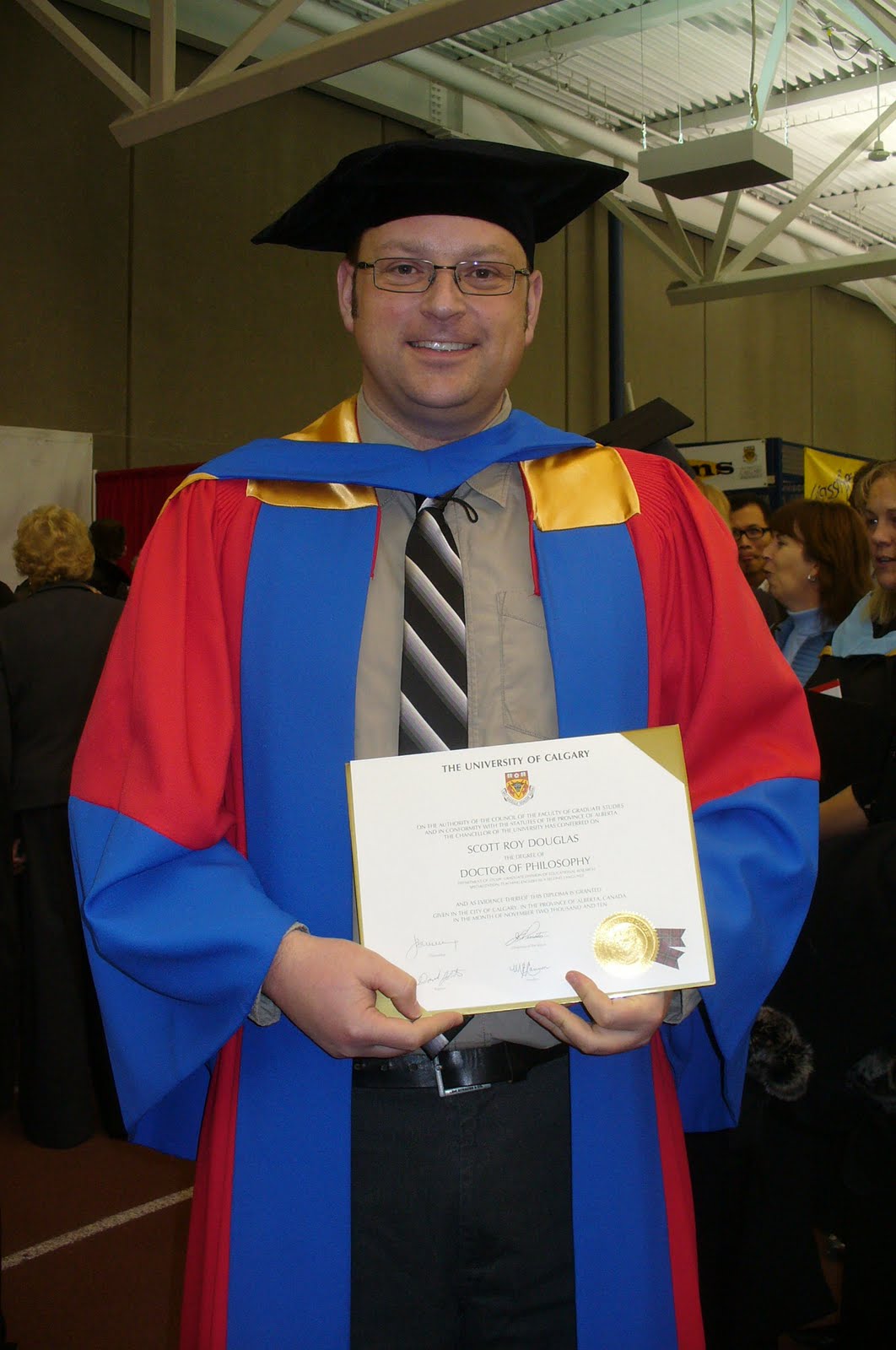
It's now official. I have a PhD! I had my convocation last Friday, and I've received my fancy piece of paper saying that I have a Doctor of Philosophy with a specialization in Teaching English as a Second Language. Hmmm, does this mean I now have to give my students more homework because I'm an "expert" now?
Convocation started off with my parents picking me up at my house. We then went to the university for the Faculty of Education convocation lunch. The lunch was really nice with posh little sandwiches and cream cake, but all I could manage was a cup of coffee. For some reason, I was actually feeling nervous, so I couldn't eat anything. This is really rare for me!
After the lunch, I went over to pick up my special robes and hood and put them on. I also picked up my degree at that time. Then, once everyone was ready, we marched into the Jack Simpson gym headed by a Scottish Piper. The ceremony started at 2:30, and it finished around 3:30. My turn came when I went up on stage and my hood was official attached to my robes. I then shook hands with a bunch of people on stage, got my picture taken, and sat back down. Once that was over, I was a doctor!
After the ceremony, my parents then took me to my favourite Chinese restaurant in Brentwood Mall, and we had Pekin Duck. It was so good. I love the little pancakes that come with the duck. We also had duck noodles, and duck tofu soup. My dad also wanted to have some vegetables with black bean sauce, and we ordered some extra ginger chicken because my mum doesn't like duck too much. She thinks they are too cute to eat.
Anyway, it was a great day! Enjoy the photos!
Me with my PhD: Me walking off the stage:
  My mother and I:
 My father and I:
 The "convocation" cake and I:

Convocation started off with my parents picking me up at my house. We then went to the university for the Faculty of Education convocation lunch. The lunch was really nice with posh little sandwiches and cream cake, but all I could manage was a cup of coffee. For some reason, I was actually feeling nervous, so I couldn't eat anything. This is really rare for me!
After the lunch, I went over to pick up my special robes and hood and put them on. I also picked up my degree at that time. Then, once everyone was ready, we marched into the Jack Simpson gym headed by a Scottish Piper. The ceremony started at 2:30, and it finished around 3:30. My turn came when I went up on stage and my hood was official attached to my robes. I then shook hands with a bunch of people on stage, got my picture taken, and sat back down. Once that was over, I was a doctor!
After the ceremony, my parents then took me to my favourite Chinese restaurant in Brentwood Mall, and we had Pekin Duck. It was so good. I love the little pancakes that come with the duck. We also had duck noodles, and duck tofu soup. My dad also wanted to have some vegetables with black bean sauce, and we ordered some extra ginger chicken because my mum doesn't like duck too much. She thinks they are too cute to eat.
Anyway, it was a great day! Enjoy the photos!
Me with my PhD:
 Me walking off the stage:
  My mother and I:
 My father and I:
 The "convocation" cake and I:
Subscribe to:
Posts (Atom)