Here are some of my random musings connected to TEAL. In particular, I'm interested in English for Academic Purposes and teacher-assessed pathways to higher education.
Sunday, June 26, 2011
Tuesday, February 22, 2011
The Lexical Anatomy of a Novice NNES Undergraduate Essay
Thursday, February 17, 2011
New Article - Just Published!
Friday, January 28, 2011
TESL Canada Call for Proposals
- Achievement outcomes
- Language and literacy
- Academic Language Proficiency
- Curriculum, pedagogy and classroom practice
- Teacher preparation
- Identity
- Assessment
- Transitions to higher education
- Program support
- Policy
- Provision of Services
Thursday, January 06, 2011
What do standardized test scores mean for undergraduate students?
I’ve been looking around at a lot of university websites lately, trying to think what scores would be needed to enter an undergraduate program, and then how much growth might be expected (needed) to occur over the course of one year of undergraduate studies in English. For now, this is just “educated” guess work, but it’s something I’d like to think more about in the future. For reference, the
Basically, while there are minimum English language proficiency requirements to enter an undergraduate program, those requirements can’t remain static. They need to grow in order to keep up with the demands of a student’s particular program of studies. A certain TOEFL score may be high enough to enter university, but it is not necessary high enough to exit a program of studies. This means that students need to continue focusing on their English throughout their stay at university.
Entrance to 1st Year Exit from 1st Year iBT 85 90 Paper TOEFL 563 577 CBT TOEFL 223 233 CAEL 71 78 IELTS 7 8 MELAB 85 90 CLBA 7/8 8/9 English 30 Diploma Exam 50% 75%
Wednesday, December 01, 2010
Happy End of the Semester!
It’s almost the end of the semester. In fact, there are only two more teaching days left, and then there are the final exams. I thought for this post, I’d give some tips on how to write an essay for the EAP 1 final exam. Let me know what you think about them!
Thirteen Steps to Writing a Short 4 Paragraph Essay for the Final Exam
Step One:
- Brainstorm three or four supporting ideas for the topic.
Step Two:
- Brainstorm three or four supporting points for each of the supporting ideas from Step One. Brainstorm facts, details, statistics, anecdotes, examples, elaborations, explanations.
Step Three:
- Choose the best two supporting ideas from your brainstorm and decide which one is the first body paragraph, and which one is the second body paragraph. Remember to save the best for last!
Step Four:
- Choose the best two or three supporting points for each of the supporting ideas you have chosen for your essay. Underline or circle them in your brainstorm.
Step Five:
- Write a thesis statement for your essay.
Step Six:
- Write a topic sentence for your first body paragraph.
Step Seven:
- Write a topic sentence for your second body paragraph. Don’t forget a transition between the two body paragraphs.
Step Eight:
- Write a concluding statement for your conclusion paraphrasing the thesis statement.
Step Nine:
- Write a general to specific introduction. It should be about four sentences long.
Step Ten:
- Write the first body paragraph. It should be about 100 – 150 words long.
Step Eleven:
- Write the second body paragraph. It should be about 100 – 150 words long.
Step Twelve:
- Write the concluding paragraph. Use added thoughts, comments, predictions, hopes, wishes, judgements, opinions, or recommendations. Do not add any new information about the topic.
Step Thirteen:
- Read over the essay carefully two or three times. Revise for ideas, and edit for grammar and mechanics.
Saturday, November 20, 2010
Extraordinary Measures and Popcorn!

Sunday, November 14, 2010
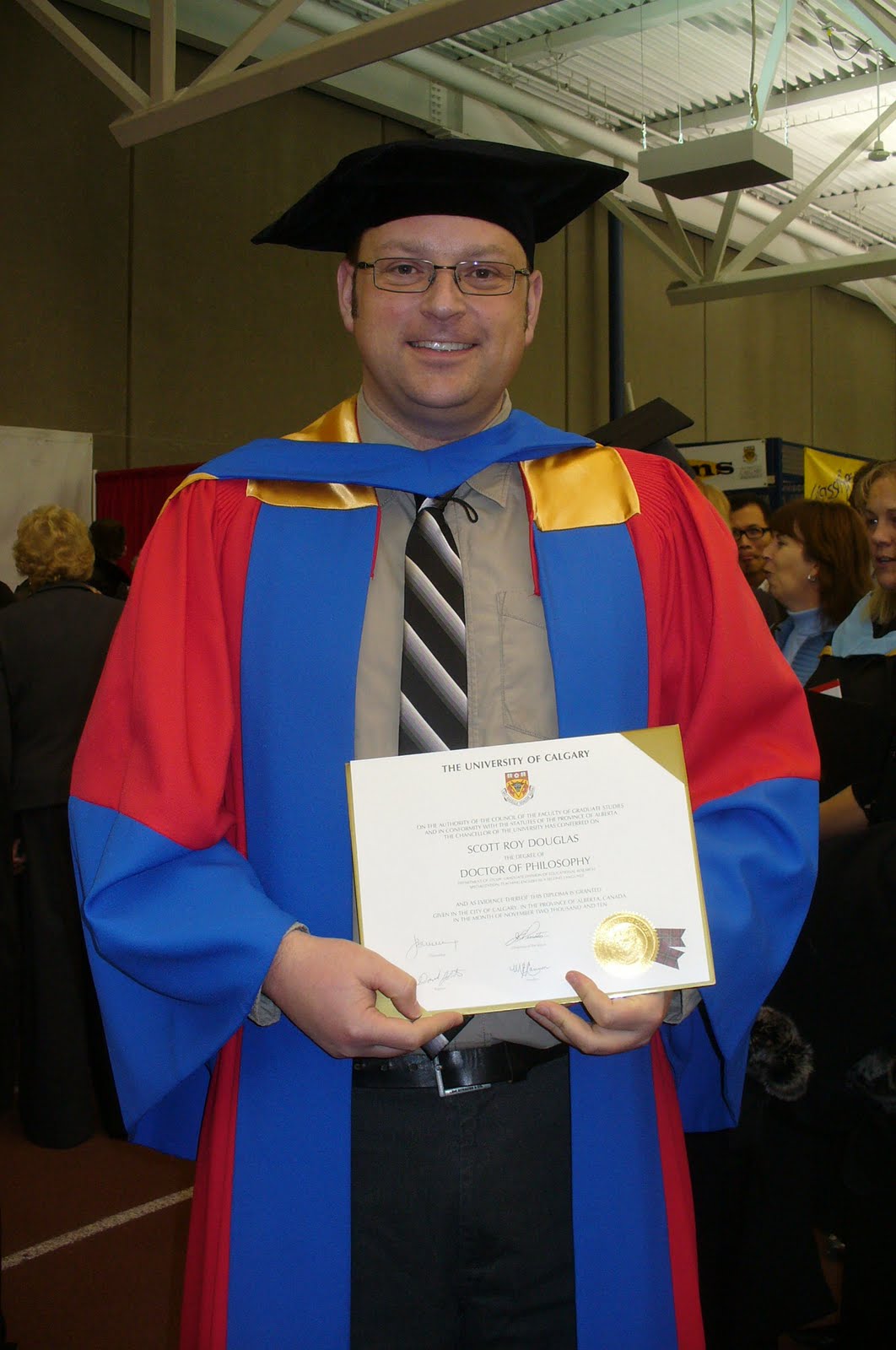
Convocation 2010
Convocation started off with my parents picking me up at my house. We then went to the university for the Faculty of Education convocation lunch. The lunch was really nice with posh little sandwiches and cream cake, but all I could manage was a cup of coffee. For some reason, I was actually feeling nervous, so I couldn't eat anything. This is really rare for me!
After the lunch, I went over to pick up my special robes and hood and put them on. I also picked up my degree at that time. Then, once everyone was ready, we marched into the Jack Simpson gym headed by a Scottish Piper. The ceremony started at 2:30, and it finished around 3:30. My turn came when I went up on stage and my hood was official attached to my robes. I then shook hands with a bunch of people on stage, got my picture taken, and sat back down. Once that was over, I was a doctor!
After the ceremony, my parents then took me to my favourite Chinese restaurant in Brentwood Mall, and we had Pekin Duck. It was so good. I love the little pancakes that come with the duck. We also had duck noodles, and duck tofu soup. My dad also wanted to have some vegetables with black bean sauce, and we ordered some extra ginger chicken because my mum doesn't like duck too much. She thinks they are too cute to eat.
Anyway, it was a great day! Enjoy the photos!
Me with my PhD:
Tuesday, November 09, 2010
The Strange Case of Dr. Jekyll and Mr. Hyde
Monday, November 08, 2010
Back from Edmonton!

I’m back from
However, conferences are more than just presentations. It’s also a great chance to meet up with friends from all over the province. I was really happy to meet colleagues from
All in all, it was a great conference, and I can’t wait to go again next year!
Saturday, October 30, 2010
Alexander the Great Presentations
I wonder how many of my students have started to go out for coffee with a friend, even if they both speak the same first language, and promise themselves that they will only speak English for 30 minutes. I remember learning that languages are learned when you have two people who are willing to negotiate meaning with one another. That is, if one person doesn’t understand, the other person doesn’t mind trying to explain what they want to say in a different way one more time. Finding someone like that, however, can be difficult. I see it all the time, but I guess people have busy lives, and if a native English speaker is speaking to a non-Native English speaker, they don’t always have the patience to negotiate meaning. That’s why I tried recommending to my students that if they can’t find an English speaker to practice with, that’s no problem, they can just practice with each other.
On another note, my students have just finished doing their presentations on the Penguin Reader Alexander the Great. The presentations were brilliant! I was actually surprised because, to be honest, sometimes I dread presentations. They can go on and on and no one understands what is being said, and the students spend the whole time speaking into a piece of paper or with their backs to the audience talking to the power point screen. Painful! However, this time, it didn’t happen. Usually, presentation time is a time of open topics with students choosing their own group members. This time, however, I randomly chose the groups for the students, and I assigned the topics. The Penguin Reader we have been reading in class has 10 chapters, so I divided the class up into ten groups, with each group presenting a different chapter in order. Although students could search the internet for pictures and maps, they weren’t allowed to use any other information except that in their books. By narrowing down the information they could use, the students really focused on the chapter they had to present, and boy did they know their stuff! I have an entire class of experts on Alexander the Great! I think by lowering the amount of work they had to do in order to find content for their presentations, they were able to focus more on the English and delivering a good presentation. On top of all that, because the groups were randomly assigned, there were speakers of different first languages in all the groups. The working language had to be English, so it was good practice as well while they were preparing. Anyway, I was very impressed! I can’t wait for the next presentations!

Sunday, October 24, 2010
Nihongo Half Hour!

I think a lot of my students know already, but my hobby is learning Japanese! I lived in Japan for two years, and I think one of my biggest regrets is not learning how to speak Japanese fluently. I remember, when I first went to Japan, I thought it would be easy to learn the language because I had been to other places before, and I had quickly learned the local language. For example, when I was 17, I went to Quebec for six weeks, and by the end of six weeks, I couldn't stop speaking French!
Sunday, October 17, 2010
Midterm Exams!

Mid-terms are over, and I’m sure my students are sitting anxiously at home waiting for the results. I’m in the middle of marking them all right now, but I thought I’d procrastinate a bit and write in my blog.
Mid-term week is a busy week in the EAP program. It started off with the writing and grammar midterm. This year, I gave the students almost three hours to complete their writing and grammar midterm. It started off with 60 multiple choice grammar questions and the different grammar points that we studied in class, and then we had the writing section. I really wanted to see if the students were comfortable with the writing process, so I included the brainstorming, outlining, and rough draft in the exam before the students started writing a good copy. I hope that they understand that when they are writing paragraph, there are a number of steps they have to take before they get around to writing the final copy.
After the writing and grammar midterm, there was the reading midterm, which was also about three hours long. The hardest part on this midterm seemed to be the vocabulary. Actually, it was very interesting because usually I expect a few students to do really well, and a few students to do really badly, with the majority of the students doing average or okay. However, this midterm it seemed like their were definitely two groups of students. Students who did amazingly well (almost 100% on the vocabulary) or amazingly badly (almost 0% on the vocabulary)! I bet I know which students were the ones who studied their vocabulary really hard!
I also did oral exams with the students for these midterms. I really enjoy the opportunity to speak with the students one-on-one in these types of situations. I do always get the change to talk to each student in class, so it is a nice opportunity for me. Also, it was again obvious who studied! The students who studied had lots to say, but the students who didn’t open their books looked a bit shocked with I asked them some of the questions!
To end it all off, there was the listening midterm. This midterm wasn’t as long as the others, and I think some of the students really enjoyed it. Again, you could tell who studied!
Now, it’s time to finish marking the midterms, and start thinking about the final exams in December!
Wednesday, October 13, 2010
Turkey with my Parents`

I had such a great long weekend! I went to Olds on Monday for Thanksgiving Day, and I ate
It was nice seeing my parents on the weekend, and it was especially great seeing their two dogs as well. I think I must have fed them about half of the turkey off of my plate! Anyway, I can’t wait to eat turkey again. I think I’ll cook another one just for fun in November for no special reason!
Sunday, October 03, 2010
I went shopping with my PhD supervisor!

The other day, I went to a one day conference on reading with my PhD supervisor, and afterwards we went to Value Village in North East Calgary. I wonder if any of my students have ever been there. Value Village is a giant thrift shop that sells second hand clothes and other sorts of things. My PhD supervisor loves looking for treasures in this shop. She often finds name brand clothes and other high quality things for bargain prices. The only problem is that the place is so huge, it takes hours to find the treasures in the middle of all the other stuff. While my supervisor was shopping in the ladies' clothing section, I had a look around the books, and I ended up buying seven used books for only $4 each. I also bought a glass mug for $2. They were a bargain! If you are ever bored, Value Village can be a fun place to poke around in on the weekend if you are looking for fun second hand stuff. Also, if you want to get rid of your old things, you can donate your no longer wanted stuff to Value Village and they will give money to charity when they sell your old stuff. Here is their link: http://www.valuevillage.ca
Thursday, September 23, 2010
Welcome to EAP 1

My students this semester are a really great mix of people, and I think a lot of new friendships are going to be made in the class that are going to last a lifetime. I'm very excited to start this new blogging project with them, and I can't wait to read what they have to say about life, the universe and everything! As for myself, I've been blogging for almost six years now. It is still my favourite writing project, and I love blogging with my students. I hope they are going to enjoy it as much as I do.
By the way, this blog post is 198 words. That's about how much my students have to write every week!
Happy Blogging!
Friday, September 17, 2010
Link to my PhD Thesis
https://dspace.ucalgary.ca/handle/1880/48195
Sunday, August 08, 2010
I've handed in my PhD thesis!
Increasing numbers of students in both the K-12 and Post-Secondary educational systems in Alberta do not speak English as their first language. However, immigrants face multiple challenges to taking full advantage of the educational opportunities afforded by their new home. This study focuses on one period of those educational opportunities, undergraduate university education, and one set of challenges, vocabulary and academic writing. The main objective of this study was to measure the lexical richness non-native English speaking (NNES) and native English speaking (NS) undergraduate students bring with them to university in terms of lexical breadth and depth of knowledge, and compare these measures to eventual undergraduate academic outcomes. To carry this out, the Effective Writing Test (EWT) was used to compile a corpus of novice academic writing. The NNES students in the study were academically competent, as shown by their Grade 12 math marks. Nevertheless, the results showed that NNES students came to university with less robust measures of lexical richness compared to their NS counterparts. While NNES students eventually graduated from university in higher numbers, they were faced with diminished academic outcomes in terms of Grade Point Averages, Length of Program, Courses Attempted and Not Earned, and Academic Standing. Using hierarchical regression analysis, a line was traced from the initial measures of lexical richness, through EWT, and on to the academic outcomes. Measures of lexical richness strongly predicted performance on the EWT, and EWT results predicted eventual academic outcomes. The conclusion of this study is that lexical richness plays a strong role in general undergraduate writing assessment, and university level writing competence plays an important part in academic success.
Saturday, June 05, 2010
ACLA 2010
It was a great conference this year in an amazing city. I have really enjoyed my time in Montreal so far, and I have the added bonus of having uncles, aunts, cousins and my granny here too!
The main thrust of my presentation at this year’s conference was the connection between measures of lexical richness and large scale writing assessments, and the concomitant connection between large scale writing assessments and eventual academic outcomes at the undergraduate level. From this I conclude that lexical richness is an underlying variable of academic success in higher education.
It was very interesting for me to find significant correlations between measures of lexical richness taken in the first year of university studies and the Grade 12 English 30 Diploma Exam as well as the Effective Writing Test. I was then further intrigued by the correlations I found between the English 30 Diploma exam and the Effective Writing Test with GPA at university as well as other measures such as academic probation and length of program. All of this is in my presentation which you can have a look at here:
http://people.ucalgary.ca/~sdouglas/ACLA2010.pdf
Now I just have to write all of this up, along with my other findings, and I'll have a thesis . . . . . .
Sunday, May 23, 2010
Busy Writing My Thesis
My presentation was entitled: Taking Stock of the Depth of NNES Undergraduate Vocabulary. Here is the abstract of my presentation from the program book:
Part of a doctoral research project on non-native English speaking (NNES) university students and the relationship between lexical richness and academic success, this report focuses on the vocabulary errors that persist in NNES undergraduate writing for students who have fulfilled university English language proficiency requirements. Word use is analyzed in both native English (NS) and NNES writing samples from the archives of an effective writing test at a western Canadian university. This report looks at the results of the marking process and analyses the vocabulary errors made by students in the areas of meaning, appropriacy, derivation, form, omission, and style. Preliminary results show that while NS students do make word use errors, NNES students make almost three times more word errors in their essays and the errors differ in kind and seriousness. The word errors made by NNES students affect the readability of their essays, and ultimately the final marks. Participants in this session will leave with a clearer picture of the lexical errors that persist in NNES writing at the undergraduate level. The implications of the report?s findings for the teaching and assessing of NNES students who are bound for higher education are also explored.
Also, here is a link to my presentation slides - enjoy!

http://people.ucalgary.ca/~sdouglas/SRD%20BCTEAL%202010.pdf